Newsletter
Hello and welcome back for another monthly round up of all things employment law. Last month we looked at flexible working, implications of the change of prime minister and a high profile sex discrimination case involving Morrison’s. Additionally, last week we looked at the identity of the Respondent and getting locked in a fridge. This month’s update has features on Christmas Parties, the latest mini-budget implications, four-day weeks and the Fire Brigade scandal.
Christmas Party Cases

For the past couple of years many employers have been unable to host Christmas parties due to a combination of lockdowns, restrictions on numbers and general hesitancy about socializing in large groups. This year with COVID in the rear view will see a return to the status quo. This presents a nice opportunity to remind employers of some of the more interesting, shocking and outrageous cases that have arisen due to Christmas parties.
Judge v Crown Leisure Limited
In this case an employee was given verbal assurances of a pay rise by a director during the Christmas party. This was never followed up in writing but the employee resigned after the pay rise did not materialise. The resignation came two years after the party!
The employee claimed constructive dismissal but the Employment Tribunal held that an informal promise of a pay rise in an informal setting did not amount to a contractual term that the employer could be in breach of. As such the claim was dismissed. If the promise was found to be a contractual term it is likely a resignation two years later would not be sufficiently close or proximate to be a resignation because of the breach.
Westlake v ZSL London
In this case the Claimant was a zookeeper in a work place relationship with another zookeeper. Unfortunately her partner had previously been in a relationship with another colleague and this caused tension between the two. At the Christmas party a fight broke out in the coatroom between the Claimant and her love rival. Whilst it wasn’t clear who started the fight the Claimant did smash a wine glass on her colleague’s face causing a deep gash.
The Claimant was dismissed but her colleague was not. She argued the sanction was unfair as her colleague was only given a final warning. The Employment Tribunal agreed as both had committed violent conduct and the instigator of the fight was unknown. Despite the facial injury being more severe, violent conduct alone was misconduct worthy of dismissal. Despite the dismissal being unfair a 100% deduction for contributory was applied as the nature of the misconduct was so severe.
Nixon v Ross Coates Solicitors and another
A tale of office gossip. The Claimant was in a relationship with a colleague. At the Christmas party she was spotted kissing another employee and going up to his hotel room. After the Christmas shutdown, some holiday and a period of sickness absence the employee returned to the office the following February and was pregnant. This led to rumours about the paternity of the child and the Claimant raised a grievance, requested a transfer to a different office and refused to return to work until the matter was resolved.
The employer refused the transfer and did not pay the Claimant for her absence. She resigned and sought constructive dismissal. The Employment Tribunal allowed the claim as the Respondent should have allowed the transfer and investigated the grievance. However a deduction was made for 90% due to the Claimant causing the rumour that led to her resignation by being publicly kissing her colleague and going up to his room.
The above cases are some of the more extreme and salacious examples of office Christmas parties but the same advice always applies:
- Advise staff of their conduct before the event. Whilst a party it is also a work event the ramifications of indecent, raucous or scandalous behaviour could amount to misconduct and lead to dismissal. This notice should be given in writing before the event.
- Do not take action on the night. Most years solicitors hear about drunken managers dismissing employees on the spot for (often blatant) misconduct. Whilst this dismissal are likely to have heavy deductions applied if successful by simply waiting until the following day and following a fair procedure the risk of a claim is nil.
Remember that just because something happens outside of the office or normal working hours it does not make it outside the course of employment. This goes to both disciplinary issues and grievances. Employers can often deny a grievance because the party was not on work time whilst looking to dismiss for an offence that happened at the same event.
Budget announces new National Minimum Wage Rates

Another month another budget. Jeremy Hunt has announced the latest budget and The National Minimum Wage Rates are changing. Due to them being index linked and inflation hitting a high the rise is one of the biggest in years.
| 23 and over | 21-22 | 18-20 | Under 18 | Apprentice | |
| 2022 rate | £9.50 | £9.18 | £6.83 | £4.81 | £4.81 |
| April 2023 rate | £10.42 | £10.18 | £7.49 | £5.28 | £5.28 |
The above will have a substantial knock on effect for many employers as many employees will ask for similar pay rises to keep up with inflation but also to keep them suitably remunerated for their skills.
Flexible Working – The Rise of the Four-Day Week

As the above article illustrates, pay rises can be tricky to navigate in a depressed economy. This is making recruitment and staff retention one of the most challenging aspects facing employers today. One thing many employers are trialling to much success is the compressed hours, four-day week. Employees working a fulltime week over five days typically have hours compressed to 32-35 hours a week over four days with no drop in pay. Whilst not a pay rise it does effectively give more money for less work and is an attractive benefit for staff retention.
A trial group of Irish employers involved in a study by University of Dublin has found that adopting the system has not impacted productivity and all employers involved in the scheme will be continuing with the scheme with nine of the twelve having already announced a permanent transfer. In addition to being attractive staff retention method the four day-week can also save energy costs for the employer as having the office closed for one day, or, at half capacity on Mondays and Fridays, will lead to reduced consumption.
Whilst it is something many employers are naturally sceptical about it will be interesting to see how many adopt this policy and if it will become the norm in years to come.
London Fire Brigade Report Reveals Culture of Racism and Misogyny

Last month we heard of a disturbing culture in The Royal Navy submarines. This month a report has revealed the London Fire Brigade is little better. An independent review found there was a disturbing culture of bullying and harassment against both ethnic minorities and women and this was evident at all levels of the service.
The report found that women were groped by male colleagues, black firefighters were often subject to threatening racism, including an incident of having a noose put in a locker, while a Muslim firefighter would have bacon put in his sandwiches. The report was also told that the threshold for bullying and harassment in company procedures was so high that unless there was violent conduct most other offences would be written off as banter.
The commissioner of the Fire Department has stated dismissals will be made if firefighters are found to have bullied or discriminated against colleagues. However, given the cultural issues with both reporting and investigation perhaps it would be better to create better reporting and investigation procedures. In the past similar damming reports have been issued about the NHS and Civil Service suggesting the public sector needs a cultural overhaul.
Lighter Side of the News – French Employee Wins Right to be Boring
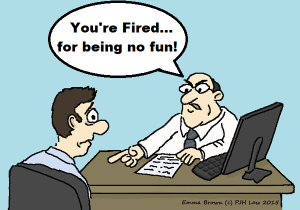
As always we cap off with a case involving the absurd or bizarre. This month we bring news of a French case that has a connection to those of us who decline to attend the Christmas party or other after hours events. In T v Cubik Partners, T was dismissed for being professionally insufficient after being held to be difficult to work with after declining invites to attend work events including team building activities and social events involving alcohol.
The court heard that the events often involved excessive drinking, promiscuity and bullying. Whilst this may have caused T to not integrate in the business it was not a ground for dismissal. Whilst not necessarily binding on English law it is interesting to know that dismissal claims could now have the boring defence in addition to the bastard’s defence for discrimination claims!